Tag Archives: featured

Encouraging activities for all in the IPCC report on food, land and climate

Recently, we wrote about the UN’s special report on climate change. More specifically, the group responsible is called the Intergovernmental Panel on Climate Change (IPCC). Today, we would like to share an encouraging excerpt:

“Consumption of healthy and sustainable diets presents major
opportunities for reducing GHG emissions from food systems and improving health outcomes (high confidence). Examples of healthy and sustainable diets are high in coarse grains, pulses, fruits and vegetables, and nuts and seeds; low in energy-intensive animal-sourced and discretionary foods (such as sugary beverages);  and with a carbohydrate threshold.”

The best way to achieve this healthy and sustainable diet is adopt a partly or fully vegan lifestyle. 3 Valley Vegans helps people in the upper Calder valley with our continued events, newsletters, social media and web pages.

Source: IPCC SRCCL final government draft (chapter 5 food security, pages 5-6). Accessed 14 September 2019.

The food security challenge

The global food system is under pressure. Over the next 35 years, the growing global population will demand more food than has ever been produced in human history!

Animation by Zedem Media via Global Food Security.

3 Oct: Climate Action Ilkley talk: are our food habits the problem or solution?

Climate change and environmental breakdown: are our food habits the problem or solution?

Eat less red meat? white meat? dairy? fish? Eat more veg? fruit? Even ‘go vegan to save the planet’. The food we choose to eat, and the farming systems producing it, have a huge impact on climate as well as on soil, water and biodiversity.

Tim Benton, Professor at Chatham House and Ilkley resident, will give an authoritative national and global perspective followed by questions and discussion.

Professor Tim Benton is the director of the Energy, Environment and Resources Department at Chatham House. He joined Chatham House in 2016 as a distinguished visiting fellow, when he was also dean of strategic research initiatives at the University of Leeds. From 2011-2016 he was the “champion” of the UK’s Global Food Security programme which was a multi-agency partnership of the UK’s public bodies (government departments, devolved governments and research councils) with an interest in the challenges around food. He has worked with UK governments, the EU and G20. He has been a global agenda steward of the World Economic Forum and is an author of the IPCC’s Special Report on Food, Land and Climate (2019), and the UK’s Climate Change Risk Assessment.

Doors open at 19.15 and the talk will start promptly at 19.30.

This talk is supported by Climate Action Ilkley, the Wharfedale Naturalists Society and the Ilkley U3A environmental forum.

Burning down the Amazon: meat and dairy at the root of it

Few will have missed the recent news reports about the awful spate of fires burning down vast areas of the Amazon rainforest, the generator of 20% of the world’s oxygen and home to 10% of the world’s known biodiversity.  However, the media were less willing to attribute the cause to anything more than the Trumpian antics of Brazil’s president, Jair Bolsonaro.   What they rarely reported was that 91% of Amazonian land deforested since 1970 has been used for livestock (sic) pasture or that Brazil is the world’s largest beef exporter.

Brazil is also the world’s second largest producer of soybeans on land that has previously been used for cattle ranching.  90% of that crop is exported worldwide as animal feed for cattle, pigs and chickens and a third of all British soy imports are for that purpose.  Your tofu and tempeh are not blameless in the Brazilian fires but meat and dairy consumption is many times worse, especially due to the inefficiency in feeding the soy to animals rather than to humans directly.  More at Vegan Sustainability.

Also, Brazilian beef is being used as a Brexit negotiating ploy.

Even though few media outlets linked the Amazon fires to meat and dairy consumption, a recent YouGov poll of more than 2,000 people showed that over half of the British public believe that reducing meat consumption should be prioritised as a key way to slow down climate change.  Reduction doesn’t mean elimination but at least this poll shows that people are making the link between meat and climate change even if Government ministers are less willing to advocate dietary change for the climate.  Sadly, the poll also found that 37% of the population is unwilling to cut their meat intake at all.  More from Edie.

Image: Amazon Fires seen from space. Credit: NASA Worldview.

National Food Strategy for England: have your say in the consultation

The government is developing a new national food strategy for England and is now consulting with individuals, organisations and businesses.  The strategy, which is due to be published in 2020, recognises that food production has a huge impact on the environment, human health and the economy.  It acknowledges that the growth of the human population poses huge risks to the food and water supply and that there are new risks posed by anti-microbial resistance. All of these factors would be improved by a move to a sustainable plant-based food production system and this is your opportunity to influence the strategy.

Please comment and say why we should move to a sustainable plant-based food system in the UK. The deadline is Friday, 25 October. Comments are welcome from individuals or vegan businesses.

The strategy will cover the entire food chain, from field to fork: the production, marketing, processing, sale and purchase of food (for consumption in the home and out of it), and the consumer practices, resources and institutions involved in these processes.

Requirements from the government

The government wants a food system that:

  • delivers safe, healthy, affordable food; regardless of where people live or how much they earn
  • is robust in the face of future shocks
  • restores and enhances the natural environment for the next generation in this country
  • is built upon a resilient, sustainable and humane agriculture sector
  • is a thriving contributor to our urban and rural economies, delivering well paid jobs and supporting innovative producers and manufacturers across the country
  • delivers all this in an efficient and cost effective way

Points you may wish to make

Comments should be 1000 words or fewer. You might like to choose from the following points or make your own comments:

  • The government has declared a climate emergency so now is the time to put this into action in this food strategy. Eating animal products has a huge environmental impact and it is clear that we will not be able to meet the Paris Agreement, and achieve net zero carbon emissions, unless as a nation we make a rapid move towards plant-based diets.
  • The recent IPCC report on land use (2019) says that we must change the way we produce food and manage land. Agriculture and forestry produces almost a quarter of the world’s greenhouse gas emissions. With a growing population we cannot continue to use land in the same way and we are now very close to dangerous tipping points.  Meat and dairy consumption will have to be cut and there needs to be a major shift to healthy and sustainable plant-based diets such as grains, pulses, vegetables, nuts and seeds.  Plant-based foods require less land, less water, produce less pollution on land and in the sea, and produce far less greenhouse gases than animal-based foods.
  • Oxford University research (Poore et al, 2018) found that adopting a plant-based diet is the “single biggest thing” individuals can do for the planet and EAT-Lancet, the latest international, peer-reviewed project of its kind, said that planetary boundaries and human health require a move towards plant-based diets.
  • Fish consumption should be cut drastically in order to prevent the loss of ocean biodiversity, habitat degradation and to reduce pollution (WWF, 2015). Ocean fishing produces nearly half of all plastic debris in the oceans (Lebreton, 2018).  Fish farming isn’t the answer: farmed fish are treated with large amounts of pesticides and antibiotics to treat diseases, particularly sea lice, which are rife in such overcrowded conditions, further exacerbating the problem of antibiotic resistance in humans. The farms pollute the surrounding water with faeces and food waste, contaminating the water and producing methane, a potent greenhouse gas (Poore et al, 2018).  One alternative for areas currently dependent upon fish farming is the move to properly managed seaweed farming which is currently underexploited in Europe (Campbell et al, 2019).
  • Poor diet is now the number one cause of death and disability in the UK resulting in a rising burden of obesity, cardiovascular disease, diabetes and cancer (Newton et al, 2015). Wholefood plant-based foods are healthier than meat and dairy and reduce the risk of these diseases which cost society billions, relieving pressure on the NHS and care sector (Fraser, 2009).
  • There should be a rapid move from subsidies that support animal farming to subsidies for plant-based foods such as vegetables, fruit, pulses and grains. This would help farmers to move to plant-based farming and improve the availability of healthy plant-based foods throughout the country.
  • Plant-based foods, particularly those produced without the use of animal manures, cause less food-borne infections than animal-based foods such as chicken and eggs. The move to plant-based foods would reduce the incidence of these diseases and therefore relieve the pressure on health care systems.
  • Plant-based foods bring investment into urban and rural economies, e.g. Heather Mills’ “vegan northern powerhouse” is already bringing investment into the north east of England.
  • The move to a plant-based diet could be encouraged by implementing inclusive and sustainable policies for public sector institutions such as schools, hospitals and care homes to offer good vegan meals as standard on menus every day. Skills in cooking plant-based foods should be part of the school curriculum so that all children are able to create healthy and tasty meals.
  • Farmers should be supported financially and practically, in the move away from farming animals to producing sustainable plant crops or ecological restoration. The Vegan Society’s Grow Green campaign should be extended and widely promoted.

National Food Strategy art

Leave your comment with the government now

UN climate change report calls for human diet changes, 3VV interviewed on BBC radio

A special report on climate and land has been commissioned by the United Nations; it found that global warming will happen faster than we think.  Efforts to reduce greenhouse gas emissions are falling significantly short unless we make drastic changes to land use for  human diets.

This message from Intergovernmental Panel on Climate Change (IPCC) may not come as a surprise to you, yet many media outlets this week are reporting on this advice to reduce meat consumption.

3 Valley Vegans’ Phil was interviewed on BBC Radio Leeds yesterday, describing how people can move towards a vegetarian or vegan diet, how it is easier than ever, and what support is available for individuals. You can hear the discussion on ‘The Big Yorkshire Phone In 08/08/2019‘ from around 1h 11m in, until early September.

The report was compiled over recent months by more than 100 experts, around half of whom hail from developing countries.

“We don’t want to tell people what to eat,” says Hans-Otto Pörtner, an ecologist who co-chairs the IPCC’s working group on impacts, adaptation and vulnerability. “But it would indeed be beneficial, for both climate and human health, if people in many rich countries consumed less meat, and if politics would create appropriate incentives to that effect.”

(Image by Luca Basili via Unsplash)

Interview with Sally Wilkinson, nutritional therapist

From time to time, we will be interviewing people in the upper Calder Valley, asking them to share their experiences about becoming fully or partly vegan. This time, we spoke to Sally Wilkinson.


What inspired you to take up a healthy, plant-based diet?

Vegucated promotional poster
Vegucated

My name’s Sally Wilkinson, and I’m a Registered Nutritional Therapist, working from Physio & Therapies in Todmorden.  I became a whole-food, plant-based vegan five years ago after watching the documentary Vegucated on Netflix, and though most of my clients aren’t vegan, people are becoming increasingly aware of the negative impacts of a diet high in animal products, and the effects of industrial farming on animals and the planet.  It’s rewarding to help individuals work towards a more plant-based way of eating, and see how surprised they are by the power of fruits and vegetables on their health.  Personally, I think it’s important to focus on a nutrient dense vegan diet, because the healthier we are, the more likely we are to remain vegan in the long term and promote a good image to others.


Why did you become a nutritional therapist?

I became a nutritional therapist because of health experiences with both myself and my daughter, who was born with a genetic condition, Pallister-Killian Syndrome, and has since developed an auto-immune condition, Hidradenitis Suppurativa.  Before I had my daughter, I was interested in health, but after she was born and I saw how it could improve her quality of life, it became a passion. There’s a saying that you take good health for granted until it’s gone, and this is absolutely true.  I’m a prime example, as I spent so many years worrying about and looking after my daughter, I neglected myself, and eventually became exhausted and ill.


So why don’t we notice until it’s too late?  Is it that we purposely ignore our bodies’ help signals?

Sometimes we do, but mainly it’s to do with the way we are designed.  Our bodily systems naturally try to keep everything in balance no matter what pressures we put on them (stress, insufficient sleep, eating a lot of high salt/high fat/high sugar foods, drinking large quantities of alcohol, living a sedentary lifestyle).  This process of keeping balance is called ‘homeostasis’.   Homeostasis means we often don’t realise our health is buckling under the sheer weight of our lifestyle until it reaches a tipping point; many times the result of a really stressful event or an infection. With the increase in obesity, diabetes, heart disease, osteoporosis and arthritis, autoimmune conditions and cancers, it is evident that greater numbers in our population are reaching the tipping point.

tangerines growing on a tree
Photo by Erwan Hesry via Unsplash

Thankfully, for most people, a simple change in diet leads to an improvement in their symptoms and conditions.  There’s nothing complicated in this – it simply means including more high fibre foods, especially eating 5 or more portions of fruits and vegetables a day (something that many of the population rarely achieve).


If something so simple can have such a high rate of success, why do so many of us find it difficult or don’t want to do it?

The reasons are complex, but my belief is that the main reason people neglect good eating habits is because the link between good nutrition and health and wellbeing is never fully understood.  Food isn’t just fuel that’s burned for energy.  Our bodies need the right combination of vitamins, minerals, fibre, phytochemicals (special chemicals in plants that help our bodies to fight off inflammation and thrive), complex carbohydrates, amino acids (proteins) and healthy fats to function properly.  Without these we can’t make sufficient energy; fight off infections; repair damage; digest food; eliminate toxins; balance mood; reproduce; develop and grow or even sleep properly.  It’s like trying to drive a car with very little oil and threadbare tyres.  You can do it, but eventually, the car will let you down.

I find a little education is all that people need to eat a healthier diet.  When clients come to see me, and I explain the science behind why their bodies are behaving as they are, and what they need to do exactly to relieve their symptoms, their focus on a healthier way of eating is astounding.


What other reasons might there be?

There’s also the fear factor.  As I explained, food isn’t just fuel for energy.  It’s also a source of comfort, and often, there’s a deeply social aspect to it.  I find people worry that in order to eat more healthily, they have to give up every single thing they love, or not be able to do the things they enjoy.  It’s not true. Recent science show that it is not just what we eat, but what we DON’T eat that is having the most negative impact on our health.   This means eating cake or chips is possible (but please not every day!), but you have to make sure you also eat plenty of fruits and vegetables (plus wholegrains and legumes) too, or your you might find your car breaking down when you’re in full throttle on the motorway.
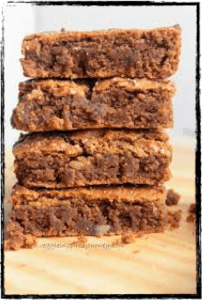
 

Stack of brownies
Recipe for flourless cranberry chickpea blondies

I’m glad that treats are still okay! Do you have a recipe for something healthy yet still a bit naughty?

To prove you can ‘have your cake and eat it’, I’ve provided a healthy version of a traditional blondie recipe.  It’s proven very popular with my clients and members of the public, and takes very little cooking skill.  It’s a good source of fibre, protein, omega-3, folate, iron, zinc, magnesium, antioxidants, and many other nutrients.


How can people find out more?

If you want any more information about nutritional therapy, you can contact me through my website, through my Facebook page, or contact me by phone on 07935 599449.  I am available not only for one-to-one consultations but also for talks and workshops.


To find out more about 3 Valley Vegans, continue exploring this website and check out our Twitter and Facebook group & page.